Newsletter #03
10 October 2024. English version, version française ici.
Dear Meso-NH users,
This is the 3rd newsletter from our Meso-NH community. You’ll find an interview with a member of the Meso-NH support team, the latest news from the support team and a list of the latest publications using Meso-NH.
Interview with Juan Escobar (LAERO, CNRS)
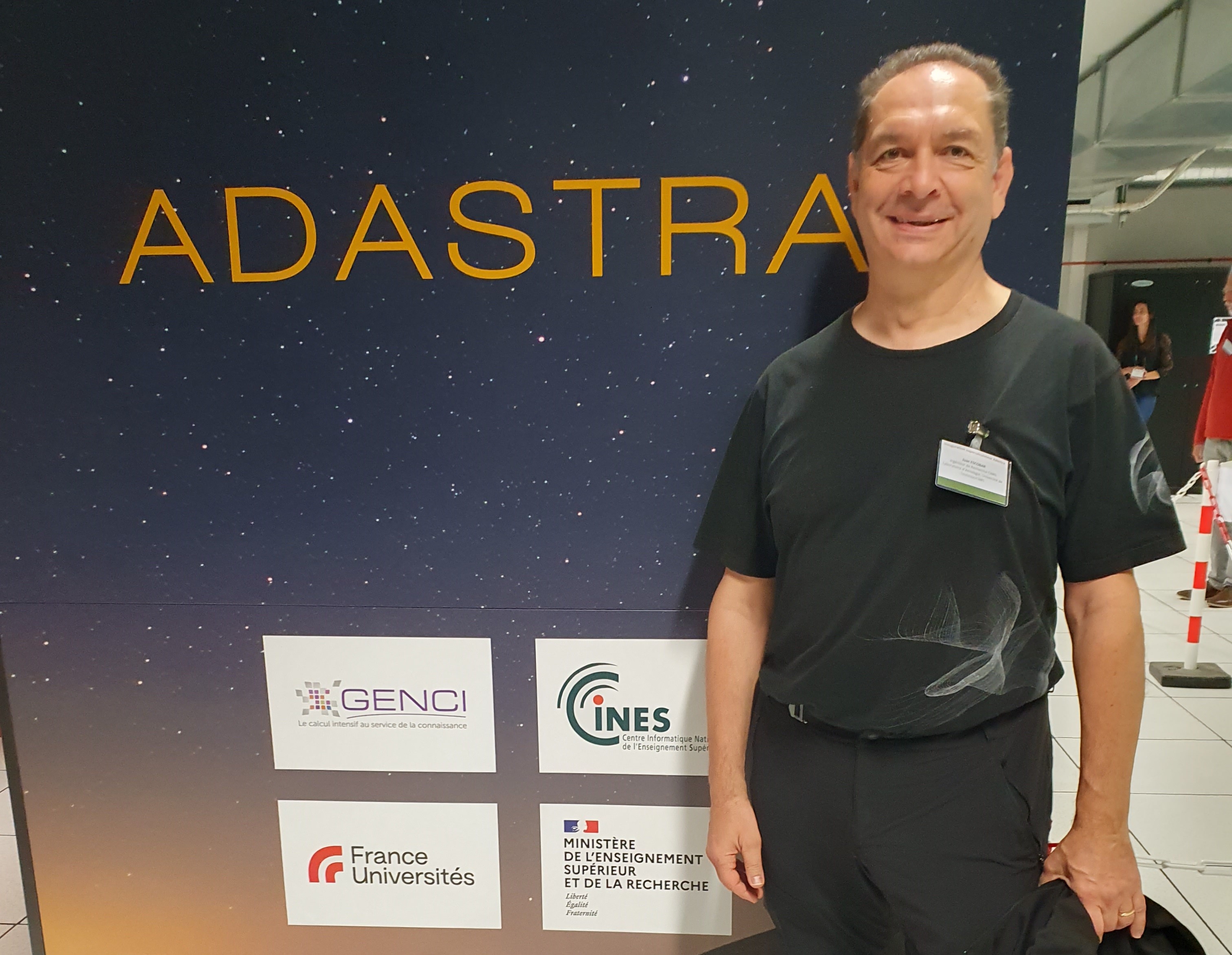
- Juan, you’ve ported Meso-NH 5-5-1 to a GPU with Philippe. Could you describe what this is all about, and the applications it opens up?
GPUs (Graphics Processing Units) have become the successors to the parallel and vector supercomputers of the 2000s (like CRAY or NEC). They have dozens of processors capable of executing thousands of instructions in parallel, with much greater memory bandwidth than CPUs, while being much more economical and less power-hungry.
Back in the 2010s, I started porting Meso-NH to GPUs using Fortran ERP compilers, using directive-based programming (DBC), which has evolved into the OpenACC standard. Today, around 90% of the most computationally-intensive parts (advection, turbulence, single-moment microphysics and pressure solver) are ported to GPUs, enabling Meso-NH to be used for scientific simulations. This version was successfully tested during the Adastra GPU Grand Challenge, simulating extreme events on around 1/3 of Adastra’s GPU partition (128 compute nodes with a total of 1024 GPUs).
- What’s the advantage of running simulations on GPU-equipped computers rather than CPU-only ones?
The main advantage of GPUs is their superior computing power. For example, on Adastra, 338 GPU nodes deliver 61 Petaflops, compared with just 13 Petaflops [1] for 556 CPU nodes. What’s more, GPUs are far more energy-efficient: at the Adastra Grand Challenge, code ran 5 times faster on GPUs while consuming 2 times less energy. This gap is set to widen. For example, the future European supercomputer in Jülich will reach 1 Exaflop [2] with its GPU partition, while the CPU partition will deliver just 50 Petaflops, or 0.5% of total power.
- Are there any situations that lend themselves particularly well to using Meso-NH 5-5-1 on GPUs?
GPUs are well suited to massively parallel simulations, such as Giga-LES, where grids contain billions of points. For example, during the Adastra GPU Grand Challenge, we used grids of 2.14 billion points (4096x4096x128) for simulations at 100-meter resolution.
GPUs also make it possible to run a large number of simultaneous simulations on smaller configurations. For example, on Adastra, we simulated 350 days of weather in Corsica with a grid of 256x256x70 points at 1 km resolution, using 1 GPU node per simulation. Thanks to this approach, all simulations were completed in just 3 days.
- What recommendations would you make to users wishing to simulate on a GPU?
You should get in touch with Meso-NH Support to get your foot in the door on the GPU. In terms of code usage, there’s no fundamental difference for someone who has already run Meso-NH on a CPU-based supercomputer. The current GPU version is based on MNH-5-5-1, so you’ll need to use this version first on the CPU to fine-tune and calibrate your simulations, and then switch to the GPU.
Of course, it is preferable to use the parameterizations already ported to the GPU, to gain in performance. However, this is not mandatory at first, as the code can be compiled to be bit-reproducible while running partly on CPU and partly on GPU.
- What are the current limitations of this Meso-NH port, and what are the prospects?
At present, only part of the code has been ported to the GPU, and that’s in version MNH-5-5-1, so we have to run simulations with this version of the code.
With the introduction of PHYEX, in versions MNH-5-6-X and MNH-5-7-X, some of the GPU porting work carried out has been lost (notably turbulence, ICE3 and sub-mesh condensation). However, Quentin Rodier and Sebastien Riette at CNRM are in charge of porting PHYEX to the GPU using the DSL (Domain Specific Language) methodology chosen by Météo-France. To this end, they have developed a Python pre-compiler, pyft_tool, enabling semi-automatic transformation of code for porting to GPUs. The library transforms the code on the fly before compiling it on GPUs, resulting in a slightly leaner source code.
Phillippe Wautelet and I are collaborating with them, contributing our GPU and OpenACC expertise to add the necessary functionalities to this pyft tool to transform PHYEX code in MNH-5-6-X and adapt it to GPUs. These features include “hand-made tools” for porting Meso-NH to GPUs, such as the automatic addition of calls to bit-reproducible mathematical functions, the automatic addition of calls to MPPDB_CHECK routines for “run-time” verification of the identity of calculations on GPU and CPU, optimized memory management for arrays, expansion of array syntax in nested loops, etc.
The MNH-5-6 + PHYEX version on GPU is well underway, and should be integrated “quickly” (before the end of the year ;-) ) in the latest MNH-5-7-X release. Other parts of the code will then be ported, such as shallow convection and LIMA.
Note
A longer version of the beginning of the interview, with more details, is available here.
An article under discussion in Geosci. Model Dev. relates the work of porting Meso-NH to GPU, it is available online here and in pdf: Escobar et al. (2024).
If you too would like to explain a development you’ve implemented in Meso-NH, or an analysis method you share with the community, please don’t hesitate to let me know by mail.
News from the support team
- Version 5.7.1 (released September 4)
List of bugfixes and main new developments here
Note that all test cases (namelists and launch scripts) are now historized and can be found in MY_RUN/INTEGRATION_CASES
- Version 5.8
A call for contributions will be launched in December. All contributions ready for December 2024, i.e. tested and delivered with a (new) test case, will be considered for integration.
- Current and recent developments
Chemistry/aerosols: the ACCALMIE project continues to restructure chemistry and aerosols in Météo-France models (ARPEGE, MOCAGE, AROME, MESO-NH) to externalize chemistry and aerosols. The ACLIB (Aerosols and Chemistry LIBrary) is currently being set up. Numerous routines will be impacted, notably inside ch_monitorn.f90, ch_* and all aer.
Version 6.0: development of the next major version has begun with the upgrade of the GPU branch (MNH-55X-dev-OPENACC-FFT) phased on 5.6 initially without PHYEX. This new MNH-56X-dev-OPENACC-FFT-unlessPHYEX branch is running on GPUs on some tests. Performance tests on GPU architectures (AMD and Nvidia) have been carried out, but this branch has not yet been validated on CPUs. The OpenACC guidelines are currently being ported (manually) to PHYEX. Turbulence has been ported. Now it’s ICE3’s turn. The branch is compiling on Belenos!
Tools: added functionality to the Python Fortran Tool library to automatically handle certain transformations of Meso-NH source code to produce code that runs on GPUs.
Software forge: the git repository host koda.cnrs has been tested. Migration on October 15. Branches on MNH-ladev will be removed unless a request to the contrary is sent to support for a particular branch.
Showcase site: procedures identified for domain name and hosting.
Coupling: parallel compilation of Meso-NH debugged when OASISAUTO is activated.
- Clean output files
useless (because empty) .des files will no longer be written. This mainly concerns PGD and DIAG files.
files containing detailed statistics on pressure solver performance are no longer written. If necessary, simply change the GFULLSTAT_PRESS_SLV parameter in modeln.f90 to regenerate them.
the file_for_xtransfer file has also disappeared (along with a few bits of code no longer required).
the OUTPUT_LISTING0 file is retained unless it is empty (Meso-NH automatically destroys it at the end; it will continue to exist during execution and in the event of a crash). This applies mainly to the MESONH executable and if no additional output is made to this file (there is some in a few places in the code).
- Meso-NH course
The next course will take place from November 12 to 15, 2024. Schedule here
Registration deadline: November 1
Registration by e-mail to Quentin Rodier
- … note::
If you have any needs, ideas, improvements to make, bugs to fix or suggestions concerning inputs/outputs, Philippe Wautelet is keen to hear from you.
Latest publications using Meso-NH
- Fire meteorology
A case study of the possible meteorological causes of unexpected fire behavior in the Pantanal Wetland, Brazil [Couto et al., 2024]
The Role of atmospheric circulation in favouring forest fires in the extreme southern Portugal [Purificação et al., 2024]
- Microphysics
Improving supercooled liquid water representation in the microphysical scheme ICE3 [Dupont et al., 2024]
Importance of CCN activation for fog forecasting and its representation in the two-moment microphysical scheme LIMA [Vié et al., 2024]
- Model development
Porting the Meso-NH atmospheric model on different GPU architectures for the next generation of supercomputers (version MESONH-v55-OpenACC) [Escobar et al., in discussion]
- Radiation
How to observe the small-scale spatial distribution of surface solar irradiance [He et al., in discussion]
- Thermodynamics over complex terrain and in urban environment
Thermodynamic processes driving thermal circulations on slopes: Modeling anabatic and katabatic flows on Reunion Island [El Gdachi et al., 2024]
Energy and environmental impacts of air-to-air heat pumps in a mid-latitude city [Meyer et al., 2024]
Note
If you would like to share with the community the fact that one of your projects using Meso-NH has been funded, or any other communication about your work (including posters and presentations available online), please write to me. I’d also be delighted to hear your views on the proposed format for these newsletters.
Happy simulations with Meso-NH!
See you soon,
Thibaut Dauhut and the entire Meso-NH team: Philippe Wautelet, Quentin Rodier, Didier Ricard, Joris Pianezze, Juan Escobar and Jean-Pierre Chaboureau.